Tuesday, 31 March 2009

Dylon Dyes 13

Back to Jeans Blue.

I decided it was time to throw out the instructions and experiment. Well, not quite dispensing with the instructions but certainly taking it to new level.


I started by finger pleating the fabric up and squashing it into a small honey jar. The dye had been mixed up according to manufacturer's instructions for the first lot of Jeans Blue fabric ( Dylon Dyes 12). I then decanted a small amount and poured it over the fabric in the honey jar. I only just covered the fabric with dye. I popped on the lid and sat it out in the Queensland Summer Sunshine for an hour.


This is the finished piece in Jeans Blue.

Sunday, 29 March 2009

The Crafters' Way 88 - Chinese Knots

Here is this week's Messenger column.


Chinese Knotting


Chinese Knotting is a decorative art that can be traced back to prehistoric times. While the knots themselves haven’t survived the tools used to create them have. Like many of the ever-popular crafts knotting began with a practical purpose. It was used as a method of recording events, the size of the knot indicating the importance of event. Historical documents of Chinese rulers have been found that reference decorative knotting.


The art of knotting was passed down through generations over many thousands of years. During the Qing Dynasty (1644- 1911) Chinese knotting became recognized as an art. As with many of the Asian Arts rigorous apprenticeships were taken under the tutelage of a master artisan. During this period knots were used to embellish clothes, belts, swords and the must have fashion accessory of the day; snuff bottles.


In 1912, the Republic of China began its’ Cultural Revolution. It is ironic that during this period the art of Chinese Knotting all but died out. In the late 1960’s and early 1970’s Chinese Knotting began a slow resurgence in Taiwan. The National Museum began a project to seek out elders who still had the skill to teach the younger generations. By the mid 1980’s Chinese Knotting was so popular that industries began producing clothing and gifts featuring knots.


The project discovered that the best age for beginning to learn knotting was 10 years. At this age the child could easily master the 14 basic knots. From these basic knots many different shapes can be created, butterflies, flowers, dragons, birds. These shaped knots are given as good luck charms at weddings and other important events. Seems like the knot has come full circle.


Feel inspired to try knotting? Here are a few tips. Chinese Knotting is typified by the use of 1 thread. The thickness of the cord will dictate the size of your knot. Don’t try using anything smaller than 2mm. Your knot will be very small and quite fiddly to create. There are too many websites with free instructions to list here. But if you are keen to have a go just ‘google’ Chinese Knotting. Have fun.

Friday, 27 March 2009

Front and Back

Yesterday I posted some photos from the barn where I do classes. The groups were spot on time today so I took these while I was setting up.


This is from the front of the barn looking toward the Rum Distillery, it's a replica of one that was in the district early last century.


And this one is taken from the back, looking toward the Steam Engine Museum, Potters and working Blacksmiths.

Thursday, 26 March 2009

Waiting, Waiting!

I had a kid's dyeing class very late this afternoon. As usual they weren't on time. Not that this bothers me most times. I can't imagine being a parent or teacher trying to organise a group of kids from activity to activity on their first ever school camp.


Anyway, I was getting a bit bored so I snapped a couple of pics. I conduct the classes in the barn. This is a snap of the Fire Brigade Museum on the left hand side.


And this is a pic from the right hand side. The building at the top of the stairs is Todd's Cottage.

Tuesday, 24 March 2009

Headbands


I have been making headbands. This was my first effort. It's made out of the end of the fabric bolt, it always has gold writing on it. This is actually the wrong side but Alan likes the gold showing.


I am really happy with it and how little time it took.


In an effort to reduce the piles of fabric bits and pieces that clutter up my studio I made a heap more. They look great with one of my fabric brooches pinned on one side.

Monday, 23 March 2009

Dylon Dyes 12


Today I have used Dylon's new Jeans Blue. As usual the fabric on the right is the Quilter's Muslin. On the left is the Laundered Silk and the thread is the Cotton Boucle.


Over the next couple of posts I'll show how I've refreshed a pair of kids overalls. I'll also show you how I've started experimenting with the dyes. See you soon.

Sunday, 22 March 2009

The Crafters' Way 88 - Gumball Necklace

This week's Messenger column is a tutorial.


Gumball Necklace


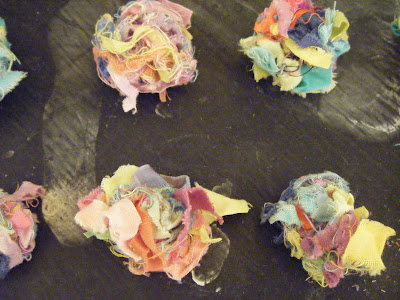
For this design you will need needle and strong thread, thimble (optional), jump rings, clasp and fabric scraps. For these fabric beads I like to save the bits that your overlocker cuts off.


Step 1: Gather your fabric scraps together and pop them in the washing machine. Sending through a cycle helps matt them together.


Step 2: Take the fabric out of the machine and pull out small balls of fabric. I usually make mine about the size of uncooked biscuit dough. Let dry thoroughly.


Step 3: Thread your needle. Hold your fabric ball firmly and start stitching through the ball to secure the fabric. Initially this seems to be never ending but it soon comes together in a firm bead shape. Once you have formed the shape you may like to add a few seed beads. Repeat for all of your balls.


Step 4: Once you have finished making your beads you are ready to create a necklace. Take 1 jump ring and sew it to the first bead. Add a second bead to the opposite side of the jump ring. I prefer to work in pairs of beads before going back and joining the pairs together.


Step 5: Add the clasp of your choice and there you have your very own gumball necklace.
In these photos I have used a selection of mixed pastel fabrics. If you want to make your beads in a particular colour palette I suggest you separate your colours before placing in the washing machine.


Back to more Free Craft Projects

Friday, 20 March 2009

Through the Front Door

Alan popped into the Pine Rivers Art Gallery and was thrilled to see that they had placed our fabric etc right at the front door.


This morning he took me to see for myself. The photo is a bit on the dodgy side but it was taken through the glass. It was very early and the gallery wasn't due to open for a couple of hours.

Thursday, 19 March 2009

Another Wholesale Order


These buckets of fabric are destined for 2 more wholesale orders.


As are these. Buckets of dyeing on every flat surface.


Would you believe that I was 2 buckets short to finish the orders off in one go. Alan's under instructions to eat more honey, real fast.


And while I was waiting for it to do its' thing I made some lace beads. The lace was left over from a class I conducted earlier in the week for the council. Waste not, want not.

Wednesday, 18 March 2009

Dylon Dyes 11


Today's Dylon colour is Tropical Green.


You may recognise the colour from the post about Velvet Black. Tropical green was the colour I used in the contrast shots.


Here it is , all on its own. Not sharing the limelight. Fabric on Right is the Quilters' Muslin. On the left is the Laundered Silk, and the thread is Cotton Boucle.


Tuesday, 17 March 2009

Update

The seed pod/cone/ thingy has been identified.


Apparently it is the seed pod of a Waterlilly. Mystery solved!

Monday, 16 March 2009

Get In The Hole!

I have finished my first ever quilt. My Art Quilt group had a swap as their monthly challenge. I posted about it a couple of weeks ago. I scored a native seed pod/cone and some thread from Belgium.


Initially I was planning a 'space' theme. This went out the window when the sun dyed fabric didn't turn out quite as dark as I thought it would. Okay, I thought to myself, don't panic, we can go with a 'Sea' theme. I left the fabric on the table. Alan passed and commented that it looked like a golf course.


Over the last couple of weeks I have half watched a lot of Golf on TV. Whenever anybody tees off some yobbo yells out 'Get in the hole'. This became my theme. On the Golf Channel they draw a yellow line indicating the line the ball is supposed to take on its way to the hole. Nick Faldo commented that he has never seen the ball go in when they do this. The hand stitching is representative of the yellow line. I couched the Belgium thread in place as divets.


As time and my skill level was limited I kept this first art quilt simple. I really enjoyed the whole process. I'm sure it won't be my last.

Sunday, 15 March 2009

The Crafters' Way 87 - Tie Earrings

Here is this week's Messenger article.


Make a Pair of Earrings


By now you are all aware of my love of repurposing everyday items into new creations. In this column I’m going to show you how you can turn an old polyester tie into a pair of earrings.
You will need: the aforementioned tie, a soldering iron, a jump ring, and pair of hooks and a 20 cent piece.

A couple of words of caution before we begin, your husband’s soldering iron isn’t going to be suitable unless it has a very fine tip. Polyester is flammable so this activity is NOT suitable for children. You also need to work in a well ventilated area.

Step 1: Turn on your soldering iron. Mine takes a few minutes to heat up. Cut 2 pieces of your tie, approx 10cm square. Place one piece right side face down. Place the other piece on top right side facing up.

Step 2: Place the 20 cent piece onto the tie. Experiment with placement for best use of design. Press down on the coin to hold steady. Trace around the outside edge with heated soldering iron. Take care not to burn your fingers.

Step 3: The tie discs should pop out easily. There may be a few rough edges, carefully run the tip of the soldering iron around the edge of the disc till smooth.

Step 4: Using the tip of the soldering iron burn a small hole near the top of each disc. The hole needs to be big enough for your jump ring.

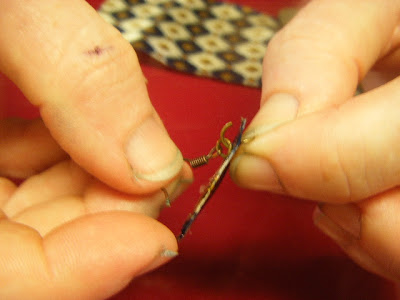
Step 5: Open out your jump ring, insert through the earring hole, add the hook and close the jump ring.

You now have your own pair of designer earrings. Just a quick note about soldering irons. Mine is a craft soldering iron, I purchased it at a discount department store in North Lakes. It came with 7 different attachments. It was also reasonably priced. If you’d like more information please contact me.
Back to more Free Craft Projects.

Friday, 13 March 2009

Off to Market We Go

We've had a busy week cutting up lots of rolls of fabric and a conducting couple of classes for the council's Older & Bolder program.


We've spent this afternoon packing the car for the Handmade Expo at the Ipswich Showground tomorrow.


Pop in and say hello, we'll be there between 8am - 2pm.

Thursday, 12 March 2009

Dylon Dyes 10

I was having a converstaion with Linda today who commented that you can't see anything in the image of the black fabric.


I explained that was why I then placed the black against the green.


Yes, I could have photoshopped the photo so that you could make out the different fabrics but then you wouldn't have seen how Truly Black the fabric was.


It's a perfect black.

Wednesday, 11 March 2009

Junk Revolution

I love this site, The Junk Revolution, it's so cool.


I copied the blurb straight from the site, it says it all.
"Inspired by the ever-growing community of antiquers, collectors, and junkers, the Junk Revolution is a place to hang out, a place to share ideas, and a place to connect with the people who share your passion for junk. Plus, you may just find some helpful tips, one-of-a-kind products, and interesting project ideas while you're here!"


You can even sign up for email newsletters to keep up to date.

Tuesday, 10 March 2009

Dylon Dyes 9

Back to Black. This dress started life as Beige (Blah!). Not my favourite.


I used the Velvet Black to dye the dress and the belt.


I then discharged colour in the shapes of circles. In this particular case it came back to rust. I highlighted the circles with 2 shades of copper fabric paint. The belt was embellished with some disc out of the tie from last week. These circles echo the circles on the hem of the dress.


And just to finish off; a small brooch I made using a Flower Loom and a Kumihimo Braid.

Monday, 9 March 2009

Dylon Dyes 8


This week I planned to start using the Greens however I changed my mind when I remembered that I had a project that I wanted to dye Black. Now a true black can be a little tricky but I was thrilled with the results from Dylon's Velvet Black.


Its not a dodgy photo, the fabric really is this black. This photo is the Quilter's Muslin, Laundered Silk and the Cotton Boucle thread.


I also took these photos to show you the Quilter's Muslin contrasted against green.


And the Laundered Silk.


The project? You will have to wait a couple of days before it's finished. Black really is beautiful.

Sunday, 8 March 2009

The Crafters' Way 86 - Handmade Strange

Here is this week's Messenger column.


Handmade Strange

In last week’s column listing upcoming exhibitions I mentioned Handmade Strange at Artisan. Artisan exhibits the work of promising and emerging artists through their annual Unleashed exhibitions. This year’s showcase will not disappoint. Curated by Tim Woodward Handmade Strange features artists Elizabeth Willing, Catherine Sagin, Hannah Cripps, Helen Rogers, Mila Vasikic and Shane Brazier.


Each artist chose their materials from the some of the most boring and everyday objects. Showing a willingness to reinterpret these objects has led to an exhibition that will puzzle, impress and entertain all in equal measure.


Hannah Cripps is a recent graduate from USQ. Hannah uses biros, paperclips and rulers in her colourful installation and sculptural works. Hannah constructs these into crystalline structures which can consume office workspace as they grow. Photo: Office Virus, courtesy of A. Higgins for artisan.


Elizabeth Willing’s piece the ‘Tip of the Icing Berg’ uses confectionary as an unorthodox material of choice. This sculpture uses marzipan icing and artificial nails which results in structures that are strangely beautiful and intriguing. Photo: Stick Insect, courtesy of A. Higgins for artisan.


Do you have a collection of sporting trophies that you don’t know what to do with? Shane Brazier’s work is sure to have you thinking. Shane works with chopped up trophy bodies to create visually stunning pieces.


The Handmade strange exhibition runs until 4th April at Artisan, 381 Brunswick St. Fortitude Valley.

Friday, 6 March 2009

More Ties

This afternoon I had a few minutes to spare so I had a play. In the latest issue of Stitch magazine Margaret Beal has a project on using a soldering iron to make buttons. I've been wanting to try this.


I had already prepared a heap of ties. I heated up the iron and started cutting out. The first one I tried was too thick. The article says 4 - 5 underlayers before placing the top layer on. I ended up using only 2 layers for the brown buttons. It was a very thick tie.


I gently ran around the edge with the iron to smooth the edges.


I eyeballed the placement of the button holes.


I tried a number of different polyester ties and decided that not all polyester is created equal. Some just would not burn easily.


With these I deliberately placed the template over creases. I want to see if they will press out or if I have to do this first.


I've burned the hole toward the top of the shape. I'm going to see how the sit as earrings. The brown Button will be listed on Etsy tomorrow.

Thursday, 5 March 2009

Dylon Dyes 7


It's a lovely sunny day, the type of day we typically associate with Queensland. I chose to try Sunflower Yellow out of the Dylon range.


Lovely clear yellow. Top Right is Quilter's Muslin, Bottom Left is Laundered Silk and the thread is Cotton Boucle.


Again I followed the manufacturer's instructions to the letter. Can't go wrong if you do that.


Here's a quick refesher of the colours I have dyed with to date. This photos is all the Quilter's Muslin.


And this one is all the Laundered Silks.