This week I was thrilled to be Artshine's Interview of the week.
Since you are working at home/studio, can you please tell us about how do you connect with other artists, and your customers (i.e. how do you network)?
I’ve struggled with this. When we first started I didn’t feel the need to network. Having always worked in an industry that was very people focussed I actually enjoyed the solitude. After a couple of years I realised that I needed to reach out to other Creatives for my own sanity. Read More
Friday, 30 July 2010
Thursday, 29 July 2010
BrisStyle's Indie Twilight Market
If you're looking for something to do tomorrow night head to Brisbane's hottest destination for everything handmade under the stars, the BrisStyle Indie Twilight Market. Showcasing a huge lineup of Brisbane's Indie Designers, you'll find an amazing array of handmade homewares, bags, jewellery, accessories, art and heaps more.
Held in King George Square between 5 and 9pm you will be able to catch a glimpse of the cast of Twilight.
For those of you who just love cupcakes the news is all good. Enticing Icing will be ON SALE. To make way for some new stock and lots of new designs, Bel is offering up to 30% off all her ready made large icing toppers.
BrisStyle's Indie Twilight Market caters for all the senses. While you're feasting your eyes, don't forget to indulge your ears by taking in the big band sounds of Brass Roots Live! as well as some cool jazz from roving musicians, the All Stars.
Why not make a night of it.
Held in King George Square between 5 and 9pm you will be able to catch a glimpse of the cast of Twilight.
For those of you who just love cupcakes the news is all good. Enticing Icing will be ON SALE. To make way for some new stock and lots of new designs, Bel is offering up to 30% off all her ready made large icing toppers.
BrisStyle's Indie Twilight Market caters for all the senses. While you're feasting your eyes, don't forget to indulge your ears by taking in the big band sounds of Brass Roots Live! as well as some cool jazz from roving musicians, the All Stars.
Why not make a night of it.
Wednesday, 28 July 2010
Photo Information
I have a Fuji compact digital camera which I have always been happy with. I recently noticed that even when I take images at the highest possible quality setting when I went into Photoshop it indicated that the image was 72 dpi. There are times when I need to take my own high res images for The Crafter's Way so I contacted Fuji to find out what I was doing wrong. The response was unbelievably quick and easy to understand. I thought it might also be useful to others so ihave posted their response here.
Most digital cameras use pixel resolution as a standard unit of measurement (PPI – Pixels per inch, Hence example:6 Mega Pixel = 6 Million Pixels) rather than DPI (Dots Per Inch, relative to printer values, most Minilab printers will print photographs at 300 DPI).
Although programmes like Photoshop have a preset that usually displays the DPI may at 72, that is only display presentation of the image to allow the software to optimise it’s graphics memory when displaying the image on screen at a faster rate.
The 72 DPI, is not a true indication of the image resolution and you would find that the pixel resolution based on the file size relates to the PPI content of your photos, which would be large enough to print images at a higher DPI (default standard of photographic lab printers is currently set at 300 DPI).
I have included information below regarding further information about pixel resolution and DPI.
To get an idea of the DPI that can be used and what print size will be achieved, simply divide the pixel dimension by the desired DPI. For example, take a photo with a pixel resolution of 1800 x 1200.1800 divided by 300 (DPI) equals 6 inches. 1200 divided by 300 equals 4 inches. Therefore you can obtain a 6x4 inch photo print at 300 DPI quality from a 1800 x 1200 photo.
Examples:
72 DPIon a 6x4" photo = 432 x 288 pixels.
300 DPI on a 6x4" photo = 1800 x 1200 pixels.
300 DPI on a 8x12" photo = 3600 x 2400 pixels.
300 DPI on a 10x15" photo = 4500 x 3000 pixels.
http://www.nikondigital.org/articles/image_size_ryan.htm
Please click on the link above to view an Image Resolution Guide, readily used by our department.
'Base' is a unit of measurement that is used with digital film scanning. Here is a guide to how the units work.....
1 Base = JPG 1MB when open, approx 200kb when compressed/ closed ( 72 DPI @ 6x4 inches ) 420 x 280 pixels.
4 Base = JPG 6MB when open, approx 1MB when compressed/ closed ( 300 DPI @ 6 x 4 inches ) 1800 x 1200 pixels.
16 Base = JPG 22MB when open, approx 3MB when compressed/ closed ( 300DPI@ 8x12 inches ) 3600 x 2400 pixels.
32 Base = JPG 39MB when open, approx 5MB when compressed/ closed (300DPI@ 10x15 inches) 4500 x 3000 pixels.
Many labs can scan these as uncompressed files such as Bitmap or Tiff.
Some third party software packages (something like Adobe Photoshop) offer the ability to magnify your photos and crop or trim areas. For best results use the highest resolution available for your camera (2 megapixels).
A camera that is capable taking a 4 megapixel image has the pixel dimensions of approximately 2400 x 1800.
To get an idea of the DPI that can be used and what print size will be achieved simply divide the pixel dimension by the DPI.
For example the maximum DPI for a normal print is 300; 2400 divided by 300 equals 8 inches and 1800 divided by 300 equals 6 inches. Therefore you can obtain a 8" x 6" print from the camera at 300 DPI. An approx guide would be:
1 megapixel (effective megapixel 1.2) = Image resolution 1280 x 960
2 megapixel (effective megapixel 2.0) = Image resolution 1636 x 1236
As digital files (such as .jpegs) taken by digital cameras do not match the aspect ratio of standard print sizes. Faced with this, our printing labs can choose to enlarge the image to fill the print entirely (but cropping some image area at the same time) or leave a white border on 2 sides and give you the whole image.
The width divided by the height of an image or "aspect ratio" is usually expressed as two integers,
e.g. width/height = 1.5 is expressed as width:height = 3:2.
3:2 aspect ratio of 35mm film, 4:3 aspect ratio of most computer
6"x4" prints, and most digital SLRs monitors and digital compact cameras
Hope you find this as useful as I did. Now I just have to come up with another reason why I take such lousy shots.
Most digital cameras use pixel resolution as a standard unit of measurement (PPI – Pixels per inch, Hence example:6 Mega Pixel = 6 Million Pixels) rather than DPI (Dots Per Inch, relative to printer values, most Minilab printers will print photographs at 300 DPI).
Although programmes like Photoshop have a preset that usually displays the DPI may at 72, that is only display presentation of the image to allow the software to optimise it’s graphics memory when displaying the image on screen at a faster rate.
The 72 DPI, is not a true indication of the image resolution and you would find that the pixel resolution based on the file size relates to the PPI content of your photos, which would be large enough to print images at a higher DPI (default standard of photographic lab printers is currently set at 300 DPI).
I have included information below regarding further information about pixel resolution and DPI.
To get an idea of the DPI that can be used and what print size will be achieved, simply divide the pixel dimension by the desired DPI. For example, take a photo with a pixel resolution of 1800 x 1200.1800 divided by 300 (DPI) equals 6 inches. 1200 divided by 300 equals 4 inches. Therefore you can obtain a 6x4 inch photo print at 300 DPI quality from a 1800 x 1200 photo.
Examples:
72 DPIon a 6x4" photo = 432 x 288 pixels.
300 DPI on a 6x4" photo = 1800 x 1200 pixels.
300 DPI on a 8x12" photo = 3600 x 2400 pixels.
300 DPI on a 10x15" photo = 4500 x 3000 pixels.
http://www.nikondigital.org/articles/image_size_ryan.htm
Please click on the link above to view an Image Resolution Guide, readily used by our department.
'Base' is a unit of measurement that is used with digital film scanning. Here is a guide to how the units work.....
1 Base = JPG 1MB when open, approx 200kb when compressed/ closed ( 72 DPI @ 6x4 inches ) 420 x 280 pixels.
4 Base = JPG 6MB when open, approx 1MB when compressed/ closed ( 300 DPI @ 6 x 4 inches ) 1800 x 1200 pixels.
16 Base = JPG 22MB when open, approx 3MB when compressed/ closed ( 300DPI@ 8x12 inches ) 3600 x 2400 pixels.
32 Base = JPG 39MB when open, approx 5MB when compressed/ closed (300DPI@ 10x15 inches) 4500 x 3000 pixels.
Many labs can scan these as uncompressed files such as Bitmap or Tiff.
Some third party software packages (something like Adobe Photoshop) offer the ability to magnify your photos and crop or trim areas. For best results use the highest resolution available for your camera (2 megapixels).
A camera that is capable taking a 4 megapixel image has the pixel dimensions of approximately 2400 x 1800.
To get an idea of the DPI that can be used and what print size will be achieved simply divide the pixel dimension by the DPI.
For example the maximum DPI for a normal print is 300; 2400 divided by 300 equals 8 inches and 1800 divided by 300 equals 6 inches. Therefore you can obtain a 8" x 6" print from the camera at 300 DPI. An approx guide would be:
1 megapixel (effective megapixel 1.2) = Image resolution 1280 x 960
2 megapixel (effective megapixel 2.0) = Image resolution 1636 x 1236
As digital files (such as .jpegs) taken by digital cameras do not match the aspect ratio of standard print sizes. Faced with this, our printing labs can choose to enlarge the image to fill the print entirely (but cropping some image area at the same time) or leave a white border on 2 sides and give you the whole image.
The width divided by the height of an image or "aspect ratio" is usually expressed as two integers,
e.g. width/height = 1.5 is expressed as width:height = 3:2.
3:2 aspect ratio of 35mm film, 4:3 aspect ratio of most computer
6"x4" prints, and most digital SLRs monitors and digital compact cameras
Hope you find this as useful as I did. Now I just have to come up with another reason why I take such lousy shots.
Sunday, 25 July 2010
The Crafter's Way 145 - Cosplay
This week's Messenger column is all about Cosplay.
A couple of weeks’ ago I attended one of Creative Moreton’s 8 x 8 Talks and discovered Cosplay. I have to admit I was a little underwhelmed initially but by the end of the talk I was fascinated. What appealed to me was the idea that Participants can display their talents as an Artist or Craftsperson in a practical way. The speaker that night was Jessica Briscoe. We had a chat about Cosplay and how interested people might get involved.
Exactly what is Cosplay? Cosplay is a multidisciplinary art form from Japan, where people recreate the costumes of their favourite anime, manga, movie or game characters, and then act in character in a public setting. Cosplay is short for ‘costume-play’.
Does it appeal to a certain age group? Cosplay appeals mostly to the 13-25 age group, because it’s a great way to express yourself. I’ve met parents and grandparents who cosplay.
Where does your inspiration come for your costumes and/or characters? I notice that most people tend to cosplay characters with similar personalities to them. When I’m reading a manga, and I see a character that makes me think, ‘I can see where they’re coming from,’. I also cosplay in a group, so some of my characters are picked because they fit in with what others are cosplaying.
What steps are involved in designing and making your costumes? Firstly I get reference images for my costume from manga, then modify a pattern and pick fabrics, then begin to sew and craft the accessories. The last thing I do is trim and style the wig, and the costume’s done!
Have you always been interested in designing and or sewing? Ever since I was little, I’ve been sewing and designing costumes. There’s just something freeing about wearing your own work, and being able to say “Look at what I made! Look how much better I’m getting!”
Have you needed to learn new skills? I’ve had to improve my sewing skills, and pick up some new ones along the way. I’m now competent in metalwork, leatherwork and wood carving.
How does somebody become involved in cosplay? There’s no real formal cosplaying groups in Brisbane, but there are occasionally informal meet-ups organized through Facebook and such. People interested in cosplay can email me at thecosplaybrigade.gmail.com, and look at our Facebook sites
http://facebook.dj/iheartcosplaybrisbane/ and http://artist.to/thecosplaybrigade/
A couple of weeks’ ago I attended one of Creative Moreton’s 8 x 8 Talks and discovered Cosplay. I have to admit I was a little underwhelmed initially but by the end of the talk I was fascinated. What appealed to me was the idea that Participants can display their talents as an Artist or Craftsperson in a practical way. The speaker that night was Jessica Briscoe. We had a chat about Cosplay and how interested people might get involved.
Exactly what is Cosplay? Cosplay is a multidisciplinary art form from Japan, where people recreate the costumes of their favourite anime, manga, movie or game characters, and then act in character in a public setting. Cosplay is short for ‘costume-play’.
Does it appeal to a certain age group? Cosplay appeals mostly to the 13-25 age group, because it’s a great way to express yourself. I’ve met parents and grandparents who cosplay.
Where does your inspiration come for your costumes and/or characters? I notice that most people tend to cosplay characters with similar personalities to them. When I’m reading a manga, and I see a character that makes me think, ‘I can see where they’re coming from,’. I also cosplay in a group, so some of my characters are picked because they fit in with what others are cosplaying.
What steps are involved in designing and making your costumes? Firstly I get reference images for my costume from manga, then modify a pattern and pick fabrics, then begin to sew and craft the accessories. The last thing I do is trim and style the wig, and the costume’s done!
Have you always been interested in designing and or sewing? Ever since I was little, I’ve been sewing and designing costumes. There’s just something freeing about wearing your own work, and being able to say “Look at what I made! Look how much better I’m getting!”
Have you needed to learn new skills? I’ve had to improve my sewing skills, and pick up some new ones along the way. I’m now competent in metalwork, leatherwork and wood carving.
How does somebody become involved in cosplay? There’s no real formal cosplaying groups in Brisbane, but there are occasionally informal meet-ups organized through Facebook and such. People interested in cosplay can email me at thecosplaybrigade.gmail.com, and look at our Facebook sites
http://facebook.dj/iheartcosplaybrisbane/ and http://artist.to/thecosplaybrigade/
Wednesday, 21 July 2010
Tweed Heads Round Up.
As usual we had a lovely time at the Tweed Heads Craft Fair. The Quota Ladies do everything to make sure that things runs smoothly. The weather was glorious although it was little cooler than previous years. Not that this bothered us. It was nice to see some new stallholders joining the fun this year. I'm going to share with you my two favourites.
The first is Linda Clark. Linda creates the coolest clothes. Great colours, lots of embellishment added with pizzaz.
I just loved her designs. I have a family do later in the year that I may just be wearing a Linda Clark Design to.
This lady's name is Myrtle. She is 90 years old and still creating the most delicate china paintings. The only time she stopped demonstrating her china painting techniques throughout the 2 days was when she popped up and bought one of Linda's Jackets.
Next year's dates are in the diary. Maybe we will see you there?
The first is Linda Clark. Linda creates the coolest clothes. Great colours, lots of embellishment added with pizzaz.
I just loved her designs. I have a family do later in the year that I may just be wearing a Linda Clark Design to.
This lady's name is Myrtle. She is 90 years old and still creating the most delicate china paintings. The only time she stopped demonstrating her china painting techniques throughout the 2 days was when she popped up and bought one of Linda's Jackets.
Next year's dates are in the diary. Maybe we will see you there?
Sunday, 18 July 2010
The Crafter's Way 144 - Textile Exhibition
Here is this week's Messenger column,Textures, Textiles & Twigs, featuring an interview with Textile Artist, Fran Robinson.
This exhibition brings together the works of three artists. Artists from Caboolture, Pine Rivers and Redcliffe represent each district of the vast region of Moreton Bay. Jim Aitkenhead’s (I studied printmaking with Jim), “The Kermack Collection”, is a celebration of his long career in printmaking. Wendy Sonnenburg's exhibition, “More than a Basket” explores handmade baskets and other forms of containment whilst Fran Robinson’s “Gifts of the Forest” is an exhibition showcasing Fran’s unique approach to contemporary embroidery. I recently caught up with Fran to discuss the exhibition and her art.
Did you create the pieces especially for the exhibition or did they evolve over time? The pieces I selected for this exhibition evolved over quite some time. The work comes together far too slowly for me to be able to fit into anyone's deadline, not even my own.
Where do you get your inspiration? A lot of the inspiration comes from my local environment or places I have visited, some painting and drawing, as well as playing on the computer, mainly with photographs but also with actual scanned objects such as leaves.
How planned is each piece before you start or does it evolve? Most of the pieces are fairly well planned before I start, as far as the colour and lines of the design go. It is really difficult to change something once it's stitched on the canvas, so it's best to try to get it the way I want the first time. A good design helps keep me on track over the weeks or months of the stitching. The textures develop once I begin the actual stitchery, often enhanced by the use of beads and unusual textured yarns which I've been collecting over quite a long time. Developing 3D areas in some of the works can add a lot of excitement.
How long have you been doing this style of art? I took up canvas embroidery in about 1980 and very soon started creating my own designs and developing my own style.
How long does an average piece of art take to create? There's no set time for a design to come about. They happen as they do. As for the rest, it depends on the size of the piece, naturally, but I've found that the actual stitching time averages out at about 40 minutes to the square inch. The smallest pieces take about ten hours each and the bigger works can take hundreds of hours over several months to complete.
Wendy Sonnenburg will be sharing her basket weaving skills on Saturday July 24 at the Pine Rivers Art Gallery. For bookings contact the Gallery on 3480 6941.The Pine Rivers
This exhibition brings together the works of three artists. Artists from Caboolture, Pine Rivers and Redcliffe represent each district of the vast region of Moreton Bay. Jim Aitkenhead’s (I studied printmaking with Jim), “The Kermack Collection”, is a celebration of his long career in printmaking. Wendy Sonnenburg's exhibition, “More than a Basket” explores handmade baskets and other forms of containment whilst Fran Robinson’s “Gifts of the Forest” is an exhibition showcasing Fran’s unique approach to contemporary embroidery. I recently caught up with Fran to discuss the exhibition and her art.
Did you create the pieces especially for the exhibition or did they evolve over time? The pieces I selected for this exhibition evolved over quite some time. The work comes together far too slowly for me to be able to fit into anyone's deadline, not even my own.
Where do you get your inspiration? A lot of the inspiration comes from my local environment or places I have visited, some painting and drawing, as well as playing on the computer, mainly with photographs but also with actual scanned objects such as leaves.
How planned is each piece before you start or does it evolve? Most of the pieces are fairly well planned before I start, as far as the colour and lines of the design go. It is really difficult to change something once it's stitched on the canvas, so it's best to try to get it the way I want the first time. A good design helps keep me on track over the weeks or months of the stitching. The textures develop once I begin the actual stitchery, often enhanced by the use of beads and unusual textured yarns which I've been collecting over quite a long time. Developing 3D areas in some of the works can add a lot of excitement.
How long have you been doing this style of art? I took up canvas embroidery in about 1980 and very soon started creating my own designs and developing my own style.
How long does an average piece of art take to create? There's no set time for a design to come about. They happen as they do. As for the rest, it depends on the size of the piece, naturally, but I've found that the actual stitching time averages out at about 40 minutes to the square inch. The smallest pieces take about ten hours each and the bigger works can take hundreds of hours over several months to complete.
Wendy Sonnenburg will be sharing her basket weaving skills on Saturday July 24 at the Pine Rivers Art Gallery. For bookings contact the Gallery on 3480 6941.The Pine Rivers
Friday, 9 July 2010
Last Minute Roundup of BrisStyle 's Eco Market
Tomorrow is BrisStyle's first ever Eco Market.
These are a few of the Marketer's you may not have caught up with.
Kim from KWCeramics.
Ange from Angelene.
And Catherine from Cairo Made That.
The BrisStyle Indie Eco Market is on Saturday 10 July, 9am-2pm, St Augustine's Church Hall and Grounds,Racecourse Road, Hamilton
Thursday, 8 July 2010
The Crafter's Way 143 - BrisStyle Eco Market
This week's Messenger column, Eco Market, has been posted a little earlier than usual. Now there is no excuse not to get down to BrisStyle first Eco Market.
This year I have been following a “green” theme, encouraging people to reuse, recycle and repurpose. If you are still having doubts about including an “eco” ethos in your crafting this market should be enough to inspire you.
BrisStyle is holding their first ever eco-friendly market on Saturday 10th July at St Augustine’s Church Hall, Racecourse Rd, Hamilton. Every item for sale must meet BrisStyle’s strict eco-criteria, guaranteeing ethical shoppers can purchase unique and exquisitely made creations without putting a strain on their wallets or our earth’s precious resources. BrisStylers have mastered the art of turning trash into treasure, creating bags, jewellery, accessories, art and much more from found, pre-loved or vintage materials.
Among the talented craft artists will be Tracey from Denim Days who creates accessories from pre-loved denim jeans. Joining Tracey will be Carla from Un Cielo. Un Cielo ('One Sky') is about unique designs from photos, hand printed on sustainable, recycled & fair trade materials. Chris from Little Chrissy will be showcasing brooches made from eco-felt (made from plastic bottles) and vintage fabrics, origami bunting and brooches made from recycled magazine pages, vintage fabric bunting, eco-felt necklaces and clutch purses made from recycled fabric. You can even pop by and say hello to me. I will be there with our Eco Dyed Fabric & Threads, and some unique pieces created from champagne wire and plastic bottle rings.
Sponsored by Brisbane’s own Eco Fashion Magazine “Peppermint”, the BrisStyle Indie Eco Market will showcase the wares of those BrisStyle members who live; craft, stitch and dye by the mantra of reduce, reuse and recycle. You can also win a subscription to Peppermint by voting for your favourite BrisStyle Indie Eco Marketeer. All you have to do is check out all the stores inside the hall and outside in the grounds then register your vote at the BrisStyle Promo Stall for your chance to win.
The Eco Markets are from 9am – 2pm. For more information, please visit http://bris-style.com/
Image is Red Seed Studio, Smoke Cushions
This year I have been following a “green” theme, encouraging people to reuse, recycle and repurpose. If you are still having doubts about including an “eco” ethos in your crafting this market should be enough to inspire you.
BrisStyle is holding their first ever eco-friendly market on Saturday 10th July at St Augustine’s Church Hall, Racecourse Rd, Hamilton. Every item for sale must meet BrisStyle’s strict eco-criteria, guaranteeing ethical shoppers can purchase unique and exquisitely made creations without putting a strain on their wallets or our earth’s precious resources. BrisStylers have mastered the art of turning trash into treasure, creating bags, jewellery, accessories, art and much more from found, pre-loved or vintage materials.
Among the talented craft artists will be Tracey from Denim Days who creates accessories from pre-loved denim jeans. Joining Tracey will be Carla from Un Cielo. Un Cielo ('One Sky') is about unique designs from photos, hand printed on sustainable, recycled & fair trade materials. Chris from Little Chrissy will be showcasing brooches made from eco-felt (made from plastic bottles) and vintage fabrics, origami bunting and brooches made from recycled magazine pages, vintage fabric bunting, eco-felt necklaces and clutch purses made from recycled fabric. You can even pop by and say hello to me. I will be there with our Eco Dyed Fabric & Threads, and some unique pieces created from champagne wire and plastic bottle rings.
Sponsored by Brisbane’s own Eco Fashion Magazine “Peppermint”, the BrisStyle Indie Eco Market will showcase the wares of those BrisStyle members who live; craft, stitch and dye by the mantra of reduce, reuse and recycle. You can also win a subscription to Peppermint by voting for your favourite BrisStyle Indie Eco Marketeer. All you have to do is check out all the stores inside the hall and outside in the grounds then register your vote at the BrisStyle Promo Stall for your chance to win.
The Eco Markets are from 9am – 2pm. For more information, please visit http://bris-style.com/
Image is Red Seed Studio, Smoke Cushions
Sunday, 4 July 2010
Saturday, 3 July 2010
The Crafter's Way 142 - Reddy Arts
This week's Messenger column - Reddy Arts.
Reddy Arts is a group of like-minded textile artists based in Redcliffe. The small group was formed about 4 years ago with the purpose of extending their quilting horizons with new and innovative methods. Under the guidance of Helen Forrest the group started making and trading postcards and then progressed to journal pages to explore new techniques. They also challenged their creativity by using “ugly fabric” or “serviettes”.
This year the group has taken on a new challenge with the creation of their first group exhibition. Altered Views represents how the group’s Textile work has altered. The themes of the exhibition are “The Gayundah” and “Time”. The members were given a photograph of the Gayundah and given no specific directions, merely to represent it as we see it, through our own altered view. Gayundah, Aboriginal for lightning, was a Queensland Navy ship. The Gayundah enjoyed a colourful history before being towed to the Woody Point foreshore and left at the base of the Woody Point cliffs to act as a breakwater.
Reddy Arts now boasts 10 members. Most are local however two live further afield; Judith Mc Kinlay is from Tasmania and Kathy O’Meara from Gympie. Other Members are Helen Forrest, Sue Duffy, Susan Pietsch, Diane Flint, Jill Burgess, Brenda Wood, Jeannie Henry and Donna Davis. Carmel Schneider is also represented in this exhibition, as she was a founding member of the group.
The Exhibition opens on Friday 9th July at 7pm at the Redcliffe Cultural Centre. Please RSVP your attendance to (07) 3351 1004 or email reddyartstextilegroup@ymail.com If you can’t make opening night the Exhibition continues until Saturday 31st July. The group is also holding an Open Day in conjunction with the Exhibition. On Tuesday 20th July, 10am – 2pm join the artists for talks, displays and textile related fun.
The photos from top to bottom: Donna Davis, Brenda Wood and Jill Burgess.
Reddy Arts is a group of like-minded textile artists based in Redcliffe. The small group was formed about 4 years ago with the purpose of extending their quilting horizons with new and innovative methods. Under the guidance of Helen Forrest the group started making and trading postcards and then progressed to journal pages to explore new techniques. They also challenged their creativity by using “ugly fabric” or “serviettes”.
This year the group has taken on a new challenge with the creation of their first group exhibition. Altered Views represents how the group’s Textile work has altered. The themes of the exhibition are “The Gayundah” and “Time”. The members were given a photograph of the Gayundah and given no specific directions, merely to represent it as we see it, through our own altered view. Gayundah, Aboriginal for lightning, was a Queensland Navy ship. The Gayundah enjoyed a colourful history before being towed to the Woody Point foreshore and left at the base of the Woody Point cliffs to act as a breakwater.
Reddy Arts now boasts 10 members. Most are local however two live further afield; Judith Mc Kinlay is from Tasmania and Kathy O’Meara from Gympie. Other Members are Helen Forrest, Sue Duffy, Susan Pietsch, Diane Flint, Jill Burgess, Brenda Wood, Jeannie Henry and Donna Davis. Carmel Schneider is also represented in this exhibition, as she was a founding member of the group.
The Exhibition opens on Friday 9th July at 7pm at the Redcliffe Cultural Centre. Please RSVP your attendance to (07) 3351 1004 or email reddyartstextilegroup@ymail.com If you can’t make opening night the Exhibition continues until Saturday 31st July. The group is also holding an Open Day in conjunction with the Exhibition. On Tuesday 20th July, 10am – 2pm join the artists for talks, displays and textile related fun.
The photos from top to bottom: Donna Davis, Brenda Wood and Jill Burgess.
Thursday, 1 July 2010
Craft Update
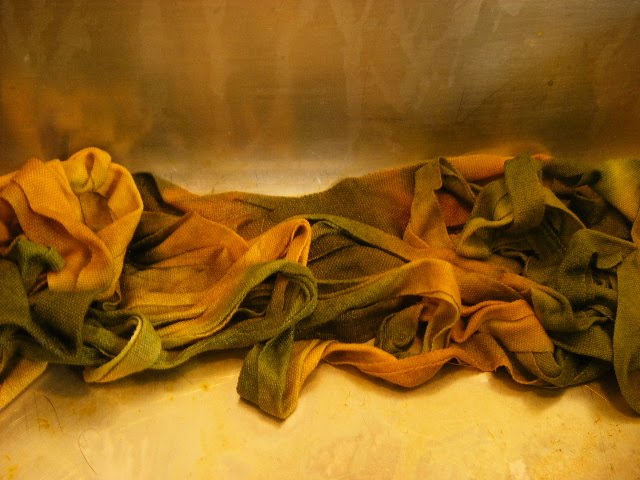
I've been diligently preparing for BrisStyle Indie Eco Market. That is between School Holiday Classes and dyeing fabric and vintage tape.
I've been making these really tiny fabric charms. Same idea as the doorstop I designed for the OzMaterial Girls but super small. Actually I started making this size first and upsized the pattern for the doorstop.
I was searching for something else and found some more Vintage Cotton Tape. I thought I had used it all up with the last batch. this was a nice surprise. I also found some fringing that was just dyeing for some colour.
I'll will finish dyeing the rest tomorrow. Not sure what colours yet, possible the rainbow. It was been very popular with the last batch.
I couldn't throw out the paper towel I was mopping up the excess dye with, it was too pretty. Once it dries I can iron it and then use it another project.
And then I could no longer ignore the fabric that was waiting to be folded. This lot still needs to be pressed. Where is my Ironing Genie?
I've been making these really tiny fabric charms. Same idea as the doorstop I designed for the OzMaterial Girls but super small. Actually I started making this size first and upsized the pattern for the doorstop.
I was searching for something else and found some more Vintage Cotton Tape. I thought I had used it all up with the last batch. this was a nice surprise. I also found some fringing that was just dyeing for some colour.
I'll will finish dyeing the rest tomorrow. Not sure what colours yet, possible the rainbow. It was been very popular with the last batch.
I couldn't throw out the paper towel I was mopping up the excess dye with, it was too pretty. Once it dries I can iron it and then use it another project.
And then I could no longer ignore the fabric that was waiting to be folded. This lot still needs to be pressed. Where is my Ironing Genie?
Subscribe to:
Posts (Atom)